World’s first Entirely Solar-Powered Airport

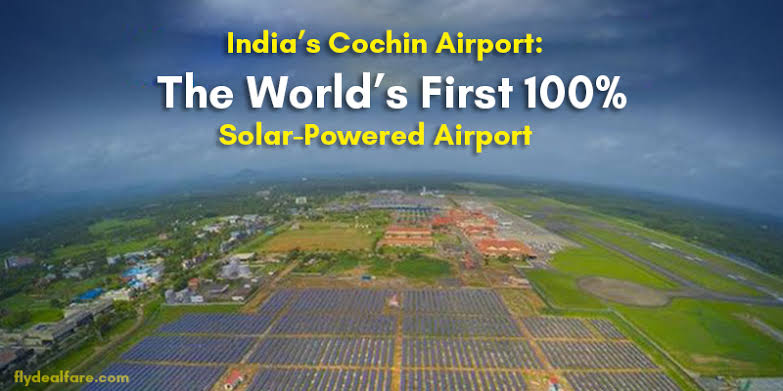
Puducherry airport has become the Airports Authority of India’s (AAI) first entirely solar-powered airport in the country with the commissioning of 500KWp ground-mounted solar power plant at a cost of Rs 2.8 crore.
The present amount of daily electricity consumption by the airport, they will be able to recover this amount in a span of roughly 5 years. The solar panels are expected to last for about 25 years, so the airport has at least two decades of significant savings based on this plan, not to mention the benefit to the environment. CIAL also has plans to sell the surplus energy produced from the plant back to the local electricity utility: Kerala State Electricity Board (KSEB).
Power plant was inaugurated by Hon Chief Minister Mr. Oommen Chandy, on 18 August 2015

It comprised 46,150 solar panels Laid across 45 acres of land near the air cargo complex. Now, Cochin Airport will have 50,000 to 60,000 units of electricity per day available to power all of its operational functions, making the airport “absolutely power neutral”.
Since commissioning, these plants have saved more than 550Mtonnes of CO2 emissions, thus contributing significantly to The efforts of CIAL to reduce environmental degradation.
The solar plant will be able to prevent 3,00,000 tons of carbon emission from coal-fired power plants over a period of 25 years, which is equivalent to planting 3 million trees or eliminating 750 million miles of driving a fossil-fuel burning car in that same time frame. In other words, apart from saving money, the plant will significantly reduce global warming by producing greener and cleaner energy, hopefully inspiring others to follow suit.
The Indian government hopes that other airports and industrial plants will follow Cochin airport’s example and turn to solar energy for their power needs. This will help the country reduce its carbon emission, thus making the environment of the entire planet safer and cleaner.

Agneepath scheme

The government of India has announced the Agneepath scheme for the recruitment of the youth of India in the Indian Armed Forces. Through this scheme, the younger population of the country is encouraged to take the military as a carrier with a high pay scale.

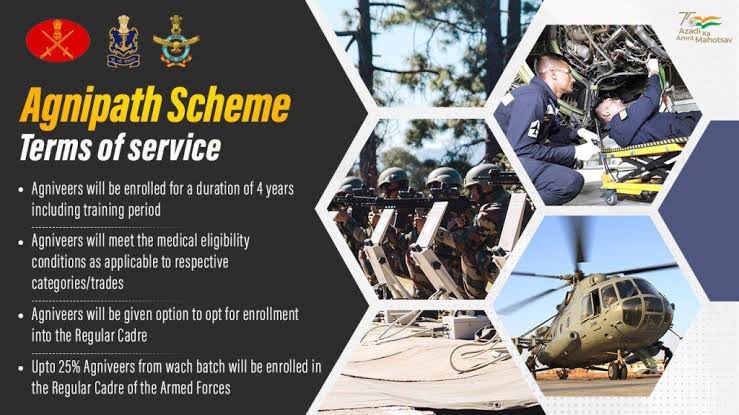
The Agneepath scheme allows the candidates to serve in Indian Armed Forces for four years. The selected candidates in the Agneepath scheme will be known as Agniveers.
The eligible age for the recruitment in the Agneepath scheme, the candidates must be between the age of 17-23 years.

The Agneepath scheme was launched on 14th June 2022.


10% of the vacancies are reserved for the recruitment in CAPFs and Assam Rifles for the Agniveers, as per the announcement by the Ministry of Home Affairs (MHA)
Under the scheme, the Agniveers will be allowed to serve the Indian armed forces for 4 years. After the completion of 4 years of service 25% of the Agniveers will be selected for the permanent commission for further 15 years based on merit and Organisation needs. The rest will be released from the armed forces with a good amount of Seva Nidhi.

Agnivesh enrolled under the Agneepath scheme will be governed by the army act 1950.
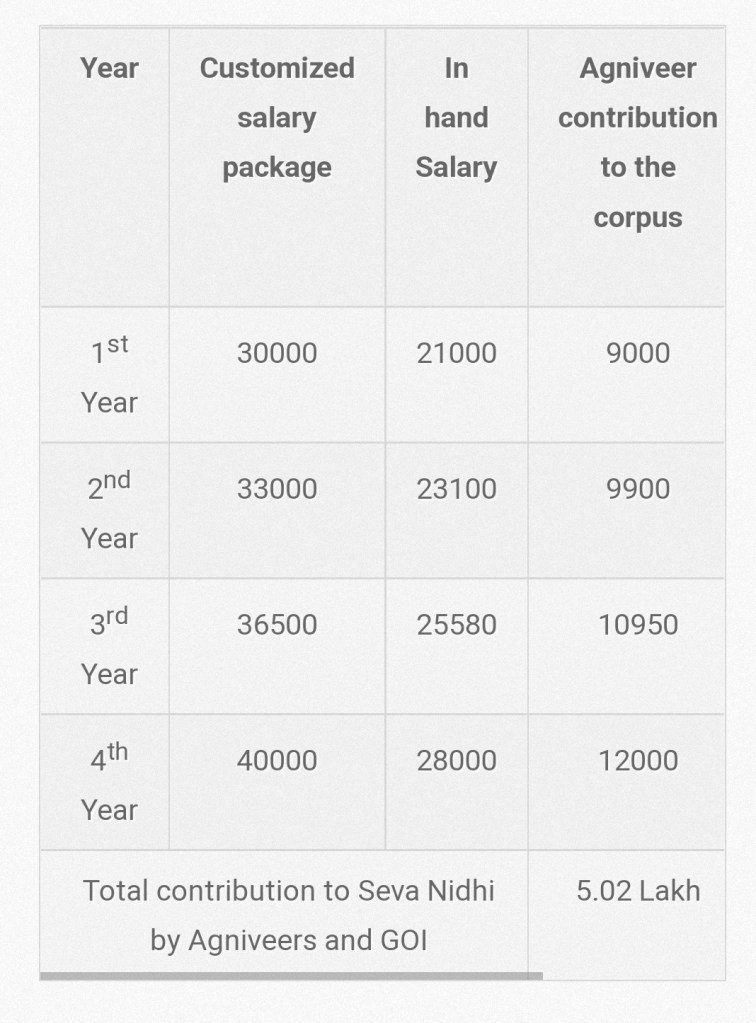
Under the Agneepath scheme, the government has introduced the Seva Nidhi package for the Agniveers. After 4 years when the Agnivesh will be discharged from the Indian arms forces, the Corpus of 5.02 lakhs will be matched by the government of India and an amount of 11 lakhs with accrued interest will be given to Agniveers.


For the first year of the service, the Agni Veer will get a 30000 customized monthly salary from which 30% will be contributed to the save energy and the net in-hand salary will be 21000 rupees.

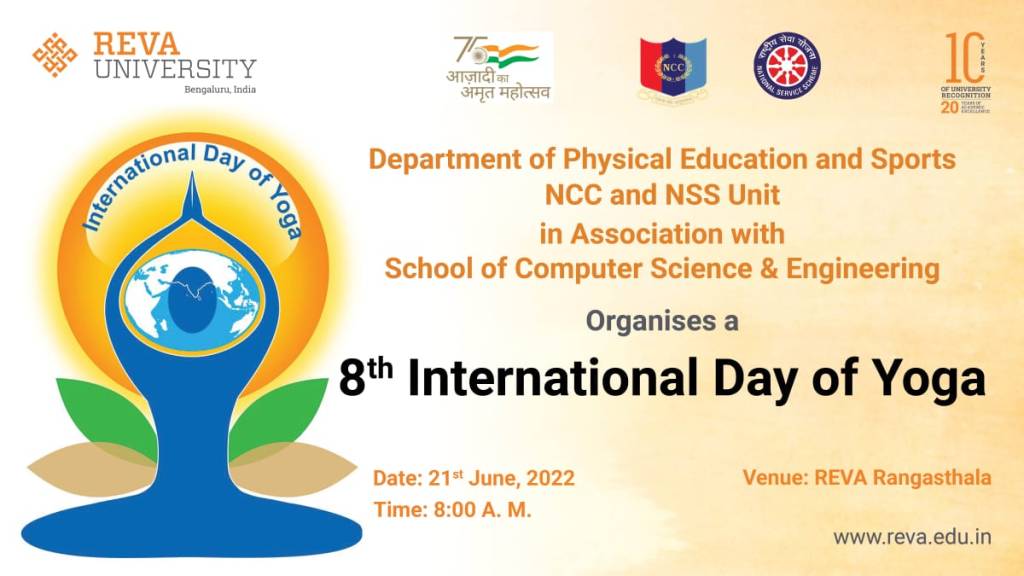
8th International Yoga Day At Reva University!


International Day of Yoga was celebrated throughout the world for first time on 21st of June in 2015. The declaration was done after the call by the Indian Prime Minister, Narendra Modi to the United Nations General Assembly on 27th of September in 2014 during his address to the UN General Assembly. On that day, record number of people practised Yoga in Delhi under the leadership of Indian Prime Minister Mr. Narendra Modi.Yoga is essentially a spiritual discipline based on an extremely subtle science, which focuses on bringing harmony between mind and body. It is an art and science of healthy living. The word ‘Yoga’ is derived from the Sanskrit root ‘Yuj’, meaning ‘to join’ or ‘to yoke or ‘to unite’.

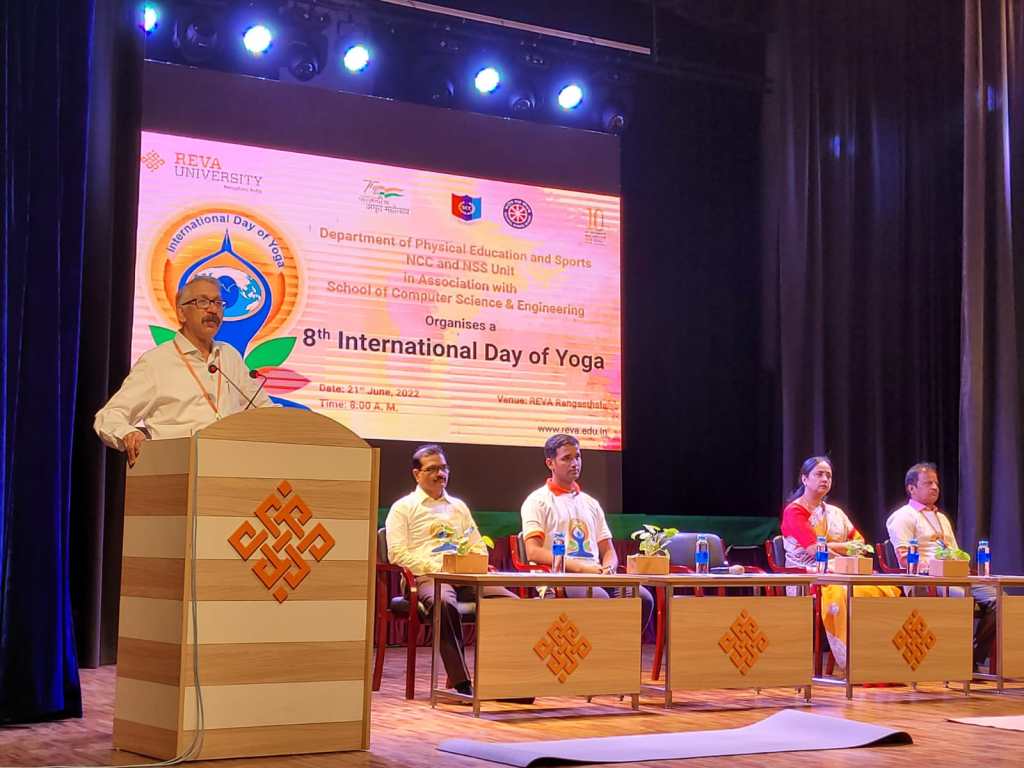
I attended 8th International Yoga Day At Reva University which was organised by department of physical education and sports NSS and NCC Unit in association with school of computer science and engineering at 0800 AM venue Reva Rangsthala.


The Chief Guest of this event was Vice Chancellor of The University M. Dhanamjaya.


All the participants provided with a T shirt imprinted one logo of Yoga and with a slogan “Yoga for Harmony & Peace”


There we took opinion about Yoga from some participants they were Calm but energized, relaxed yet strong, refreshed with slight pulsations that follows them throughout the day.


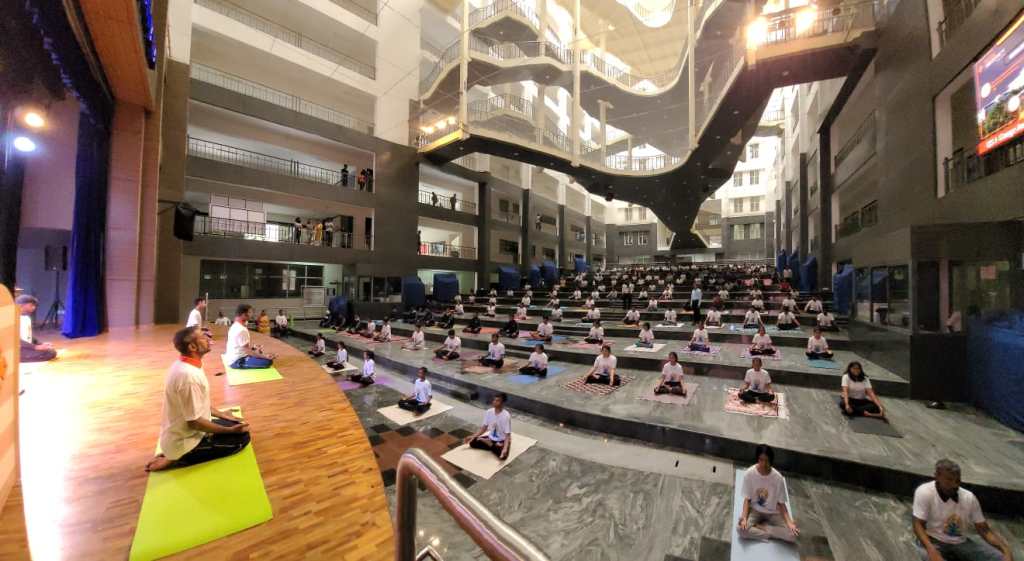
More than 200 students were there to attend this soothing session.

There we practiced different types of Yoga Asanas like and their incredible benefits.

Savasan,Sirsasan,Halasan,
Bhujangasana,Vakrasan,Vajrasana,Trikonasan Dhanurasan,Tadasana,Sukhasana


After the session the participants provided with some refreshments.

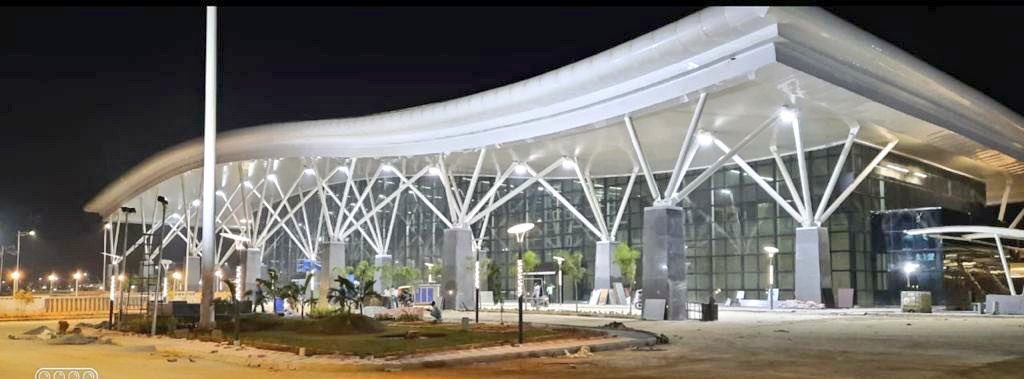
India’s first Airport Like Station!


Union Railways Minister Piyush Goyal on Thursday shared the photos of India’s first centrally AC railway terminal which resembles an airport.

Sir M. Visvesvaraya is India’s first centralised AC Terminal,


Named after one of the foremost Civil Engineers Bharat Ratna Sir M Visvesvaraya.
A benchmark for future Railway terminals. It will meet the future connectivity needs of Bengaluru & promote the city as the epicenter of socio-economic development.


The station building is of 4,200 square meter covered area to cater to daily footfalls of 50,000.
It has a fully air-conditioned entrance lobby and a well-marked parking space for four-wheelers and two-wheelers with a capacity of 250 and 900 respectively.
Wide Foot over bridge and two subways (with ramps—Divyanjan friendly) connecting all the platforms. Escalators, Lifts to facilitate passengers movement, besides stairs: Divyang-friendly Railway Station. One dedicated ticket counter also provided for Divyangjan/differently-abled.
The terminal will have seven platforms, three enabling lines and three pit lines. The terminal is built in an area of 4,200 sq. km and is expected to get footfalls of more than 50,000 on a daily basis with 50 trains running on an average per day.
The terminal will have a well marked parking space for 250 four wheelers, 900 Two Wheelers, 50 Auto Rickshaws and 20 Cabs
A dedicated bus bay – For holding buses to provide a multimodal seamless connectivity to important places in the city.Well designed spacious landscape in circulating area.
Recycling plant with capacity of 4 lakh litres of water and rain water harvesting.
According to the railway officials, the air-conditioned SMV Railway Terminal is a ₹314 crore project. It has solar rooftop panels and rainwater harvesting mechanism.
The officer said it has an upper-class waiting hall and reserved (VIP) lounge, food court, escalators, lifts connecting all platforms to facilitate passenger movement to all seven platforms, foot-over-bridge connecting all platforms, along with two subways.

Design a site like this with WordPress.com
Get started